Tuesday, 29 September 2015

Ten top tips for a great animation

Taken from http://www.bbc.co.uk/news/world-21151539


Ten tips for a great animation


This year the BBC is looking into the future, to find out what it holds for health, education, transport and even love. The season is called "What If?" and we asked you to send us your visions of the future. Hundreds of you did, the competition is now closed and we will be announcing the winners on March 25th.
Pororo
Image caption Pororo by Choi Jong-Il
To get you started, we asked South Korea's award-winning animator Choi Jong-il for his top tips.
Choi Jong-il is most famous for creating Pororo, a character who has become one of the nation's most popular cultural exports.
In South Korea the little penguin is so powerful he is called President Pororo and has his own theme park.

Here are Choi's top tips for creating a brilliant animation

•Gather as much information as you can

When you're trying to imagine what the future will look like find all the information you can from sources such as books, magazines, films and documentaries.

•Make your content different

There's no shortage of material about the future. It's better to make your content different from everything else, rather than making new content on the same theme.

•Make a story, not a description

#BBCWhatIf
If what you make is just about the future and there's no story to it, that's a documentary not an animation. A story is a crucial element that can make your animation more original.

•Make it punchy

However well-developed your story is it will go to waste if it can't be told in the 50-second running time. It is best to limit your story to about 20 cuts.

•Engage your audience

A story should be something that people can easily identify with; if your story is hard to understand, people will not be able to engage with it.

•Make it for children

Animation itself isn't just for children, but it's a medium they're more familiar with so it's important to make a film that can be understood by both children and adults.

•Make use of your characters

It can be a person, an animal or even a robot that you use to lead your story. The characters will act as a guide for the audience, leading them into the story and giving them a clearer understanding and greater emotional involvement with what is going on.

•Stay one step ahead of what the audience expects

Pororo creator Choi Jong-il
Image caption Choi Jong-il
Your animation will appeal to the audience better if it draws them into an unexpected story with a twist that no-one could have predicted.

•Humour works

It's not so easy to touch the audience but we can make them laugh. Humour will give your audience a positive impression.

•Sound effects

Sound effects and a musical score can play an important role. Good sound effects can work harmoniously with the visuals, but be careful; using sound effects badly can create unwanted results - and for this competition any music must be your own creation.

Tuesday, 22 September 2015

Conventions of Animation

I found this really good website that works on the conventions of animation written by a GCSE student that's doing animation for GCSE.


Here's the link:http://rkaracomputeranimation.blogspot.co.uk/

Step-by-Step : How to Make an Animated Movie

Taken from http://cgi.tutsplus.com/articles/step-by-step-how-to-make-an-animated-movie--cg-3257


Step-by-Step : How to Make an Animated Movie


In this in-depth article, Pratik Gulati walks us through the many stages involved in creating an animated movie from scratch, whether it be the next Hollywood blockbuster or the shortest of short films. So if you're thinking about trying it yourself and want to know how it's done, or even if you're just curious about the process, this article is one you don't want to miss.

The production pipeline of a typical animated short or a movie can be divided into three stages : pre-production, production and post-production. In this article we will be discussing these three key stages in detail.

The first process in the animation pipeline, and also one of the most important, is pre-production. It begins with the main concepts which are initially turned into a full story, and then, once the story has been finalized, other things such as the script, shot sequence and camera angles are worked on.
Some major components of pre production are Story Boarding, Layouts, Model Sheets and Animatics.

...they also provide a visual reminder of the original plan; something that can be referred back to throughout the production.
The Storyboard helps to finalize the development of the storyline, and is an essential stage of the animation process. It is made up of drawings in the form of a comic strip, and is used to both help visualise the animation and to communicate ideas clearly. It details the scene and changes in the animation, often accompanied by text notes describing things occurring within the scene itself, such as camera movements.
Not only can storyboards be especially useful when working in group environments (something quite common in the animation industry,) but they also provide a visual reminder of the original plan; something that can be referred back to throughout the production.


Once the storyboards have been approved, they are sent to the layout department which then works closely with the director to design the locations and costumes. With this done they begin to stage the scenes, showing the various characters' positions throughout the course of each shot.

Model sheets are precisely drawn groups of pictures that show all of the possible expressions that a character can make, and all of the many different poses that they could adopt. These sheets are created in order to both accurately maintain character detail and to keep the designs of the characters uniform whilst different animators are working on them across several shots.
During this stage the character designs are finalized so that when production starts their blueprints can be sent to the modeling department who are responsible for creating the final character models.

In order to give a better idea of the motion and timing of complex animation sequences and VFX-heavy scenes, the pre-visualization department within the VFX studio creates simplified mock-ups called “Animatics” shortly after the storyboarding process.
These help the Director plan how they will go about staging the above sequences, as well as how visual effects will be integrated into the final shot.

Now that the storyboard has been approved the project enters the production phase. It's here that the actual work can start, based on the guidelines established during preproduction. Some major parts are layout, modeling, texturing, lighting, rigging and animation.

[layout artists] produce the 3D version of what storyboard artists had previously drawn on paper.
Using lo-res models or blocks of geometry in the place of the final set and characters, the Layout Artist is responsible for composing the shot and delivering rough animation to the animators as a guide. What they produce is the 3D version of what the storyboard artists had previously drawn on paper.
During this stage the Director approves camera moves, depth of field and the composition of the models making up the set and set dressing. It is then the responsibility of the Modeling department to deliver these approved set, prop and character models in the final layout stages.

Modelers are usually split into two or more departments. Whilst organic modelers tend to have a sculpture background and specialise in building the characters and other freeform surfaces, hard-surface modelers often have a more industrial design or architectural background, and as such they model the vehicles, weapons, props and buildings.
Working closely with the Art Directors, Visual Effects Supervisors and Animation Supervisors, modelers turn the 2D concept art and traditionally sculpted maquettes into high detail, topologically sound 3D models. They then assist the Technical Animator and Enveloper as the model has a skeleton put in place and the skin is developed. Following this, the model may be handed back to the Modeler, who will proceed to sculpt facial expressions and any specific muscle tension/jiggle shapes that may be required.
Once the model is approved, it will be made available to the rigging and texture paint departments, who complete the final stages in preparing the model for animation and rendering. With luck, the model will move through the production pipeline without coming back for modeling fixes, although some amount of fixes are inevitable - problems with models sometimes don't appear until the rendering stage, in which case the lighter will send the model back to be fixed.

Whether creating a texture from scratch or through editing an existing image, Texturing Artists are responsible for writing shaders and painting textures as per the scene requirements.
Working hand-in-hand with the surfacing and shading departments, textures are painted to match the approved concept art and designs which were delivered by the art department. These textures are created in the form of maps which are then assigned to the model.

...lighting TDs combine the latest version of the animation, the effects, the camera moves, the shaders and textures, and render out an updated version every day.
Not only does a Lighting Artist have to think lighting the individual scenes, they also have to consider how to bring together all of the elements that have been created by the other departments. In most companies, lighting TDs combine the latest version of the animation, the effects, the camera moves, the shaders and textures into the final scenes, and render out an updated version every day.
Lighters have a broad range of responsibilities, including placing lights, defining light properties, defining how light interacts with different types of materials, the qualities and complexities of the realistic textures involved, how the position and intensity of lights affect mood and believability, as well as color theory and harmony. They are required to establish direct and reflected lighting and shadows for each assigned shot, ensuring that each shot fits within the continuity of a sequence, all the while aiming to fulfill the vision of the Directors, Production Designers, Art Directors and VFX Supervisors.

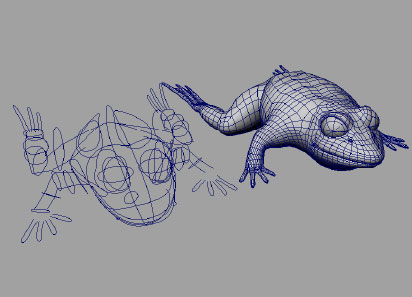
Rigging is the process of adding bones to a character or defining the movement of a mechanical object, and it's central to the animation process. A character TD will make test animations showing how a creature or character appears when deformed into different poses, and based on the results corrective adjustments are often made.
The rigging department is also involved in developing cloth simulation – so as well as making a character able to clench their fist or rotate their arm, the rigging and cloth department is responsible for making their costume move in a believable manner.

...planning a character's performance frame by frame uses the same basic principles first developed for 2D animation.
In modern production companies, the practice of meticulously planning a character's performance frame by frame is applied in 3D graphics using the same basic principles and aesthetic judgments that were first developed for 2D and stop-motion animation. If motion capture is used at the studio to digitize the motion of real actors, then a great deal of an animator's time will also be spent cleaning up the motion captured performance and completing the portions of the motion (such as the eyes and hands) that may not have been digitized during the process.
The effects team also produce elements such as smoke, dust, water and explosions, although development on these aspects does not start until the final animation/lighting has been approved as they are integral to the final shot and often computationally heavy.

Post-production is the third and final step in film creation, and it refers to the tasks that must be completed or executed after the filming or shooting ends. These include the editing of raw footage to cut scenes together, inserting transitional effects, working with voice and sound actors and dubbing to name just a few of the many post-production tasks.
Overall, however, the three main phases of post-production are compositing, sound editing and video editing.

The compositing department brings together all of the 3D elements produced by the previous departments in the pipeline, to create the final rendered image ready for film! Compositors take rendered images from lighters and sometimes also start with compositing scripts that TDs develope in order to initially comp together their dailies (working versions of the shot.)
General compositing tasks include rendering the different passes delivered by a lighting department to form the final shot, paint fixes and rotoscoping (although compositors sometimes rely on mattes created by a dedicated rotoscoping department), as well as the compositing of fx elements and general color grading.

This department is responsible for selecting and assembling the sound recordings in preparation for the final sound mix, ensuring lip sync and adding all of the sound effects required for the final film.

Video editing is the process of manipulating and rearranging shots to create a seamless final product, and it is at this stage that any unwanted footage and scenes are removed. Editing is a crucial step in making sure the video flows in a way which achieves the initial goal. Other tasks include titling and adding any effects to the final video and text.

The production pipeline detailed above is broadly common in most studios, however each studio is likely to have a custom pipeline determined by the type of project they are currently undertaking. A 2D production pipeline starts with workbook and goes all the way through final checking, composting and film output, whilst the 3D CGI production process emphasizes the design, modeling and rigging and animation stages. Moreover, animation production is a very coordinated process where different teams of artists work together while utilizing optimum resources and achieving the initial goal in the time available.


Tuesday, 15 September 2015

The Start of The Project- Research

So for research I've found a good website called the history of animation. Here is the link: http://history-of-animation.webflow.io/


Here is the Brief for the animation


Animation: an extract of approximately 45 seconds to 1 minute.

You have 4 weeks to research/screenshot the following items:
  • codes and conventions of your chosen production
  • history
  • target audiences
  • methods of production
  • anything else

Friday, 4 September 2015

The History of The video game reviewer

Taken from http://www.usgamer.net/articles/a-brief-history-of-games-journalism


A Brief History of Games Journalism

Over the past four decades, games journalism has undergone some major evolutions. We look at how it's changed over the years.

I've called this piece "The Brief History of Games Journalism," but to be honest, the term "games journalism" doesn't sit particularly well with me. I don't necessarily categorize games writing as journalism per se. 
There are elements of journalism in what we do - mostly seen on business-focused and high-end intellectual sites where fact-reporting analysis with little personal interpretation makes sense in terms of professional industry coverage. Consumer-facing sites and publications, on the other hand, tend to be far more enthusiast in nature. While some do try to be a little more reportage than others, most sites are far more entertainment-focused in their tone and style, where you expect the writer to be an ardent proponent of the fundamental subject matter he or she is talking about. The general expectation is that the author of a piece is a knowledgeable advocate about their specialized topic - something that's not always true in journalistic coverage of broad subjects and events. 


What I've just described are pretty much the traits of what used to be called the "enthusiast press", back when magazines were the only option when it came to video game information. It's a style of reporting that's seen across many different areas of consumer interest, particularly entertainment, and it's a legitimate and accepted form of writing. I just see it as different to the more impartial news-oriented, investigative form of traditional journalism that dates back to the early 18th century. 3
And speaking of which, the traditional press wasn't particularly interested in video gaming during its early years. It was seen as more a novelty than a genuine form of entertainment. However, when Exidy's Death Race appeared in 1976 featuring gameplay that enabled players to deliberately drive over people, the resultant political furor suddenly got the press very interested. Indeed, it helped set off a decades-long attitude of "games are evil," that still exists in some corners of news journalism and political auspices even today.


The Beginning

Back in the mid 70's, there was no dedicated video games press. The closest thing to that was trade periodical Play Meter, launched in 1974, which covered arcade games, but very much from a business angle. The first consumer gaming magazine wouldn't appear for another seven years, when, in November of 1981, British publishing company EMAP launched Computer and Video Games magazine. 
Just a couple of weeks later, the first US games magazine appeared in the form of Electronic Games magazine. Founded by the late Bill Kunkel and Arnie Katz, both these pioneering journalists had covered games for Video magazine, but this was the first time a magazine completely dedicated to gaming had been seen in the states. The writers of the era were all trained journalists, and even though they were often games enthusiasts, you can nevertheless see a more classical reporting style coming through in what they wrote in those early days. It was more restrained and less hyperbolic than the style of games journalism that would emerge only a few years later. 


In Europe, CVG covered all aspects of video gaming, and also included type-in BASIC listings – simple games that users could input themselves, should they be so inspired. These listings were often long, complex, and sometimes even buggy (wait ‘til next month for the fixes!), and the fruits of the painstaking labor required to enter these reams of BASIC text were often barely worth it. Still, these listings did help hopeful young programmers learn the basics of programming, so they were of use for sure. 
In the states, EG focused purely on commercial products, and avoided any aspects of DIY gaming. Where CVG and EG shared common ground, though, was in their style of writing. Since this was the very dawn of games writing, there was no precedent in terms of tone and style of games coverage. 
The writers of the era were all trained journalists, and even though they were often games enthusiasts, you can nevertheless see a more classical reporting style coming through in what they wrote in those early days. It was more restrained and less hyperbolic than the style of games journalism that would emerge only a few years later.
PR's early days
The relationship between journalists and PR folks is a complex one. At odds in terms of objectives, PR's aim is to obviously glean favorable coverage, while the journalist is ideally looking to report the "truth" as they see it.
In the early days of the games industry, many developers had a direct relationship with journalists, since they couldn't afford to hire PR and marketing people themselves. As the industry matured, and publishing companies began to dominate, PR began to become more professional. Events promoting major games began to occur, and unsupervised access to developers increasingly became a thing of the past - unless they were independent.
As the games launch/event culture proliferated through the 90's, so did the perception that there was a conflict of interest when journalists received promotional freebies at these events (from cheap tchotchkes like pens and t-shirts to expensive items like hand-held gaming systems), or (through the 00's) were flown across the country and put up in plush hotels (most recently, Call of Duty review events). While there's pretty much no evidence of PR influence ever changing review scores or ensuring positive coverage, most publications set limits on what was acceptable in terms of launch events and goodies. They also ensured that there was full disclosure about the nature of events they were attending. A far cry from the early 90's when pretty much anything went.
This helped stem the public perception that there was somehow collusion between certain publishers and journalists, but even now, this area of the profession is still highly monitored and scrutinized.


Evolution One

With an industry that was in the midst of a revolution, and with an audience that was fervent and extremely excited by what was going on, the lack of visceral enthusiasm in existing magazines was seen as an opportunity by the new wave of publications being launched in the mid-80’s – especially in Europe. Magazines created by journalists-turned-gamers began to feel somewhat staid and unexciting. Also, many of the writers of the time didn't necessarily have the in-depth, expert knowledge of their gaming readership – so to fill that gap, magazines began to hire gamers-turned-journalists. Essentially, up-and-coming writers with deep gaming knowledge who could talk to the readership using the same terms and slang they spoke. 
A British magazine called Personal Computer Games was one of the first to do this, followed by CRASH magazine – dedicated to the ZX Spectrum micro – which turned things on its head by featuring reviews written by kids local to the magazine’s offices in Ludlow, England. The magazine where I got my first gig, a Commodore magazine called ZZAP! 64, featured a team that was exclusively gamers – which resulted in a magazine filled with slang terms and contemporary phraseology that resonated with gamers. 
However, while some more traditional industry folk saw this sort of writing as “amateurish,” the readers responded very positively. Finally, there were magazines that spoke their language and mirrored their enthusiasm. The odd typo and sometimes poorly constructed English didn’t matter: what counted was that these reviewers were "real" gamers who really knew their stuff – and were excited to talk about it. 
Of course, not all magazines followed this style. The more news-focused trade and consumer weeklies, and slightly more academic broader interest computer magazines still continued to report in the more traditional journalistic style, essentially resulting in two types of magazines – the "serious" games industry press, and the more hyperbolic consumer/enthusiast gaming press. 
Something that's important to note is that at this time, many readers of magazines were quite young. During the 80's, the average age of a computer magazine reader was 16 years old, because kids welcomed gaming with open arms, while adults were much slower on the uptake. This also had a certain influence on European magazines, where younger readers often saw more colorful expression and puerile humor as positives, and weren't shy about writing into magazines and letting the writers know this. 


Europe's Boom. America's Bust

While Europe was seeing an explosion in evolution one video game magazines, in the States, the opposite was happening. Following the devastating crash of the video games market in 1983, most magazines had closed shop in the wake of marketing spending falling to an almost absolute zero. EG magazine had gone bi-monthly to try to weather the storm, but ended up going out of business in 1985 (although it did eventually have a second run of issues between '92 and '95). The only survivor of the 18 magazines that had been launched pre-crash was Computer Gaming World. However, US publications began to re-appear during the mid to late 80’s, and by the end of the decade were back to full strength, thanks to the likes of Gamepro, Nintendo Power and Electronic Games Monthly. 


While the US publishing market picked up the pieces, over in Europe, magazines were flourishing, and their hyperbolic nature had continued to escalate, leading to what sometimes felt like min-maxing of the verbiage used in good and bad reviews. Great games were received with copious praise, whereas poor games were lambasted with language you simply didn’t see echoed across the pond – and indeed don't see written in gaming publications today (but funnily enough, you do often hear spoken by pundits on YouTube – but more about that later). British magazines like Your Sinclair, Amiga Power, and Mean Machines are all examples of publications that pushed the boundaries of humor and reviewing parlance.


Part of the reason why so many magazines in Europe were able to develop their editorial humor to such a degree was simply that the way magazines are published there enabled them to do so. All across Europe, magazine distribution is exceptionally well run and efficient, and popular magazines can literally sell out their entire print run thanks to targeted sales locations and very tight distribution patterns. In the states, distribution was far slower, almost completely untargeted, and far less efficient. At best, publishers could expect to sell around a third of the magazines they printed, and the rest were lost or dumped when they didn’t sell.  
What this meant was European magazines could make a profit just by news-stand sales alone, while American magazines were essentially printing three magazines just so they could sell one – and that meant that newsstand profits didn't exist.


Subscriptions were far more popular in the States, but even then, their traditional low cost meant that subscription sales were break even, and not a profit center. Where revenue was generated was in advertising – so as long as a magazine had ads, it was viable. Ads were a source of revenue in Europe too, but they were less important than in the states. Because of that, there was far less pressure put on reviewers and writers when it came to negative coverage of games – because losing ads here and there didn't drastically affect the bottom line; it was considered par for the course to occasionally piss off a publisher/advertiser with poor coverage. 

In the US, however, there was far more nervousness about upsetting publishers, because pulled ads put a magazine's bottom line in jeopardy. This resulted in a tempering of language – or simply not covering a game if its coverage would be controversial.  


This made some European mags feel more “honest,” simply because there was a perception that writers could say whatever they wanted. However, while this say-what-you-think style helped allude to a feeling of freedom of speech, US magazines were no less honest – they were simply more conservative in their praise and criticism. This did change a little as the 90’s rolled around, and magazines like Gamepro and EGM began to read a little more European-like in their rhetoric. However, the extreme language tended to be used more for the positive than the negative, and the specter of pulled advertising meant that editorial teams still often ran into business and management issues when it came to publishing severely critical pieces.


The Rise of Digital Publishing

As the 90's wore on, something new emerged – the Internet. The first dedicated gaming web site was launched in November 1994, when print fanzine Game Zero became an online concern. Over the next few years, other small companies launched gaming websites, and major publishing companies, many of whom trepidatiously stepped into this new online publishing world with no idea just how important their websites would eventually become, soon joined them. 
In those early days, working on a website wasn't necessarily seen as a prestigious thing, and speaking from first-hand experience, many of the most junior writers at publishing companies were given the reigns to these emergent websites. I was at IGN in 1997 – although wouldn't be called that for another couple of years – and that was most certainly the case for most of the team I managed. Because of this, early Internet writing was seen as haphazard and somewhat amateurish.


The reason for this was that magazines were on a long monthly cycle, and had generally larger, more experienced teams that included Managing and Executive editors who scrutinized pages and ensured that what was printed was as clear and error-free as possible. Not so online, where an often-punishing daily schedule emphasized speed and quantity over quality. This isn’t to disparage online writers – after all, I was one during this period – but cranking out news stories, reviews, tips and whatever else was being published required working far faster and far more prolifically than producing magazine content. Generally speaking, it was self-published work, and as such, far more mistakes were seen, which resulted in the perception that online writing was inferior to print.


However, as we've seen before, consumers are often prepared to put up with a "lesser" product if it's more interesting and convenient than another, and in the case of online, the speed at which information was disseminated was often weeks ahead of print. Slowly, but surely as the millennium turned over, we began to see a dramatic migration of readers out of the traditional print publications to online. While the effects wouldn't truly kick in until the late 00's, the turn of the century was the turning point for magazines. Any publication that didn't have a parallel online publication was in deep trouble.


The Impact of Community Comments

Another major thing happened during this era that would change the nature of online journalism considerably – community commenting. In the early days of the Internet – hard though it is to remember – there was no community commenting. It wasn't until the early 00's when forums and the rise of article-specific commentary began to appear, and that had a huge effect on the way writers wrote. 


Before that point, their word was largely gospel. While readers would certainly write in to magazines to give feedback, it required pen, paper and a stamp to do so. That small effort provided a fairly large filter for comments,– simply because throwaway knee-jerk reactions would seem less compelling when someone wrote them out – assuming their words even made it to paper. And even then, comments received by publications were essentially private. Sure, almost every publication printed letters, but they picked and chose what to publish. Ultimately, reader feedback was largely benign and unthreatening.


Online comments, however, were open to everyone – and required almost no effort to write. All of a sudden writers were exposed to every possible opinion from every kind of gamer, from superfans who very likely knew more about the game than the reviewer did, to those who might pick apart the way something was written. 

Suddenly, anyone writing particularly vehemently about any topic could become a target for online rage. No matter what your opinion, there was almost always somebody out in the ether who might feel aggravated or enraged by what was said – and the nature of online commenting meant that with just a few keystrokes, they could vent their anger with ease. This had a profound effect on writing. All of a sudden, journalists had to temper their comments, and think about what they were writing far more deeply than they had on magazines. That's not to say magazine writing is thoughtless – far from it. But there was a degree of tempering and self-censorship that went into online writing to ensure that the writer said what he or she wanted to say, but not in a way that would become a lightning rod to their readership. 
Some may disagree with my assessment of how community commenting changed games journalism, and there are always exceptions to the rule, but for the most part, I believe the rise of community commenting did have an effect on many writers and what they wrote – and not necessarily a negative one. Sure, community comments themselves can be a nightmare, but the realization that people were watching and scrutinizing what was being written ensured that writers paid more attention to what they said, and indeed how they said it.


New Games Journalism

Another influential change to games journalism came in 2004 when British journalist Kieron Gillen wrote a post on his blog about new games journalism. Here, he essentially challenged the status quo, and talked about New Journalism applied to video game writing. 
It was an interesting piece, and one that resonated particularly with "quality" gaming sites and magazines who wanted to move beyond the rather stale two-decade-old standard established in the early days of games journalism, and elevate games writing to something more erudite and worthy. Not all sites changed their tone, but we did see the rise of a generation of new journalists who wrote deeper, more thoughtful pieces in magazines like PC Gamer and Edge, and later, we'd see more academic writing on the likes of 1UP, Polygon and Grantland.


The Rise of YouTube and Twitch

The cycle of games coverage evolution has continued in recent years with the rise of YouTube and Twitch. This is the most significant challenge to the status quo since the advent of the Internet. 
In the same way that "real gamers" changed the style and tone of coverage during games journalism's early years, so too are the new breed of "influencers" – gamers who've taken to YouTube and Twitch to cover games on a digital video format. 
These new media folk essentially filled a gap that was not being effectively addressed by major publishers – very personal, specialized, or non-traditional takes on video gaming on digital video format. More importantly, they also provided an alternative form of gaming information consumption for younger gamers who were less interested in reading the mostly text output of the traditional press, and instead wanted to watch and listen to people play and talk about games.


What that means over the long term is a probable shakeout of the traditional media. YouTube and Twitch viewerships already dwarf the readers of old-school gaming media, and games publishers are now spending just as much time courting influencers as they are gaming journalists. That's not going to affect coverage too much, but what will is marketing spending. The traditional gaming press is essentially supported by advertising and marketing dollars from publishers – as it always has been – but if that support begins to be pulled in favor of spending money with influencers, or because it's seen as not worth it, that will have a radical effect on the current publishing landscape. 

The interesting thing is that the influencers don't necessarily play by the same rules or follow the same standards as the traditional gaming media. There have already been examples of paid coverage of product by major influencers, and they're not always up-front about their editorial standards, and the nature of their coverage. That's understandable, since they're not journalists by trade, and indeed their viewership mightn't necessarily care about that, but the fact that most traditional outlets follow a published set of standards is something that essentially sets them apart from influencers. 
Ultimately, regardless of official standards or lack thereof, I think however games journalism, and indeed the new breed of influencers evolve, it's critical that whatever is said or written is underpinned by full disclosure, so that viewers and readers know exactly what it is that they're watching or reading. That way it's clear whether the coverage being provided is independent, paid for – or whatever muddied waters lie in between. 

Thursday, 3 September 2015

The History of Computer Games

Computer and Video Game History
Taken from   http://inventors.about.com/library/inventors/blcomputer_videogames.htm
Spacewar Screenshot                  


illustration of a spacewar video game by mary bellisIn 1952, A.S. Douglas wrote his PhD degree at the University of Cambridge on Human-Computer interraction. Douglas created the first graphical computer game - a version of Tic-Tac-Toe. The game was programmed on a EDSAC vaccuum-tube computer, which had a cathode ray tube display.
William Higinbotham created the first video game ever in 1958. His game, called "Tennis for Two," was created and played on a Brookhaven National Laboratory oscilloscope. In 1962, Steve Russell invented SpaceWar!. Spacewar! was the first game intended for computer use. Russell used a MIT PDP-1 mainframe computer to design his game.
In 1967, Ralph Baer wrote the first video game played on a television set, a game called Chase. Ralph Baer was then part of Sanders Associates, a military electronics firm. Ralph Baer first conceived of his idea in 1951 while working for Loral, a television company.
In 1971, Nolan Bushnell together with Ted Dabney, created the first arcade game. It was called Computer Space, based on Steve Russell's earlier game of Spacewar!. The arcade game Pong was created by Nolan Bushnell (with help from Al Alcorn) a year later in 1972. Nolan Bushnell and Ted Dabney started Atari Computers that same year. In 1975, Atari re-released Pong as a home video game.


Larry Kerecman was one of the first first operators of video arcade games, including Computer Space. He writes that, "The brilliance of these machines was that Nolan Bushnell and company took what was computer programming (in Space War) and translated it into a simpler version of the game (no gravity) using hard-wired logic circuits. The printed circuit boards that comprise electronics of these games use integrated circuits called small-scale integrated circuits. They consist of discrete logic chips and gates or gates, 4-line to 16-line decoders, etc. straight out of the Texas Instruments catalog. The shape of the rocket ship and flying saucer even are visible in a pattern of diodes on the PC board."
In 1972, the first commercial video game console that could be played in the home, the Odyssey was released by Magnavox and designed by Ralph Baer. The game machine was originally designed while Ralph Baer was still at Sanders Associates in 1966, Baer managed to gain his legal rights to the machine after Sanders Associates rejected it. The Odyssey came programmed with twelve games.
In 1976, Fairchild released the first programmable home game console called the Fairchild Video Entertainment System, and later renamed Channel F. Channel F was one of the first electronic systems to use the newly invented microchip invented by Robert Noyce for the Fairchild Semiconductor Corporation that allowed video games to not be limited by the number of TTL switches.
On June 17, 1980, Atari's "Asteroids" and "Lunar Lander" were the first two video games to ever be registered in the Copyright Office.